
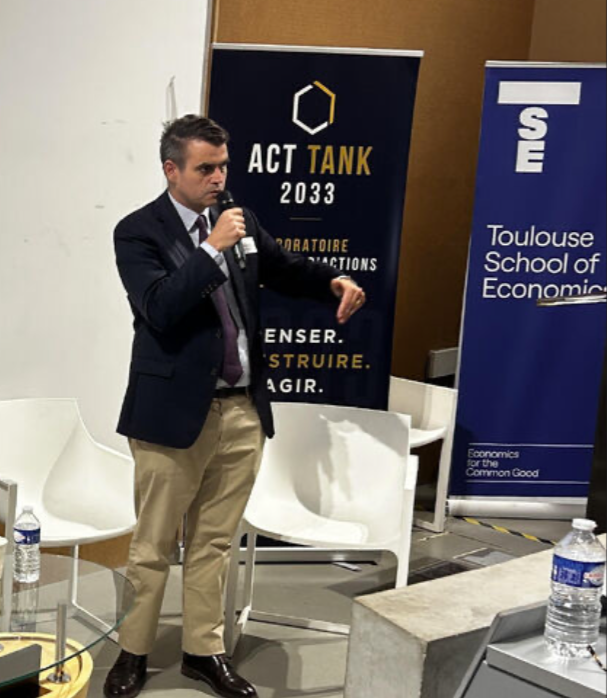
Economic and cyber sovereignty: FIDELILIUM at the heart of regional challenges
On the occasion of the regional launch of Act Tank 2033 at the Toulouse School of Economics, discussions highlighted a major strategic challenge: economic sovereignty as a driver of regional attractiveness.
In this context, FIDELILIUM, represented by its President Nicolas Malbec, provided key insights into an increasingly essential dimension: digital sovereignty and cybersecurity.
A keynote focused on the critical challenges of digital sovereignty
During the panel discussion, Nicolas Malbec shared an operational perspective on the ongoing transformations, emphasizing a fundamental principle:
> There can be no sustainable economic sovereignty without effective control of digital risks.
His presentation was structured around five key pillars:
- Technological dependence as a strategic risk: Cloud infrastructures, industrial systems, and critical suppliers remain largely subject to foreign jurisdictions.
- Data as a strategic asset: Protecting data is essential to ensuring both business competitiveness and regional resilience.
- The fragility of digital value chains: A single weak link—whether a service provider, software vendor, or supplier—can compromise an entire ecosystem.
- The cybersecurity maturity gap among regional stakeholders: SMEs, mid-sized companies, and public authorities remain insufficiently protected against rapidly evolving cyber threats.
- The need to embed cybersecurity into industrial strategies from the outset: Cybersecurity must be integrated by design rather than treated as an afterthought.
FIDELILIUM: Committed to Strengthening Sovereignty
Through this contribution, FIDELILIUM reaffirmed its positioning:
> Supporting public and private organizations in managing digital risks as a prerequisite for strategic autonomy.
Nicolas Malbec's intervention reflects operational realities observed across the field:
- Cyber threats have become systemic.
- Attacks now directly target industrial and regional value chains.
- Sovereignty challenges extend far beyond governments and now affect the entire economic ecosystem.
FIDELILIUM operates at the intersection of cybersecurity, strategy, and sovereignty, providing:
- Comprehensive cybersecurity audits and risk assessments.
- Incident response and crisis management capabilities.
- Strategic guidance aligned with organizations' long-term objectives.
Regional Attractiveness: Cybersecurity as a Competitive Advantage
One key takeaway emerged from the discussions:
> Cybersecurity is becoming a decisive factor in regional attractiveness.
A region capable of ensuring:
- The security of its critical infrastructure.
- The protection of strategic data.
- The resilience of its economic stakeholders.
naturally becomes more attractive to investors, industrial companies, and international partners.
From this perspective, FIDELILIUM's contribution highlights a significant shift:
> Cybersecurity is no longer merely a technical issue—it has become a strategic lever for competitiveness and sovereignty.
Supporting the Reindustrialization Agenda
As Act Tank 2033 begins its work, particularly around the theme of reindustrialization, the role of cybersecurity is emerging as a fundamental pillar.
Securing:
- Industrial systems.
- Supply chains.
- Regional economic ecosystems.
will be essential to any successful reshoring initiative or industrial development strategy.
Nicolas Malbec's participation in this event reflects a core conviction shared by FIDELILIUM:
> Economic, industrial, and regional sovereignty now depend on a deep understanding and effective management of digital and cyber risks.
In a context marked by geopolitical tensions and the reshaping of global economic balances, organizations and regions that fully integrate these challenges into their strategies will gain a decisive competitive advantage.